
yasa.EpochByEpochAgreement#
- class yasa.EpochByEpochAgreement(ref_hyps, obs_hyps, subjects=None)[source]#
Evaluate agreement between two hypnograms or two collections of hypnograms.
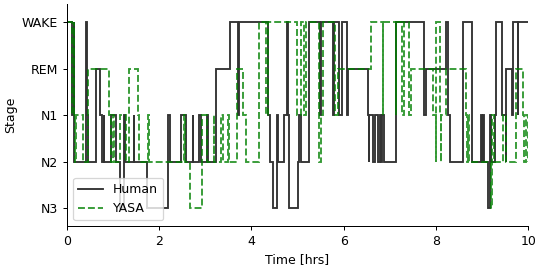
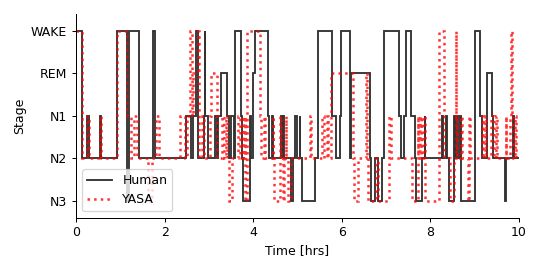
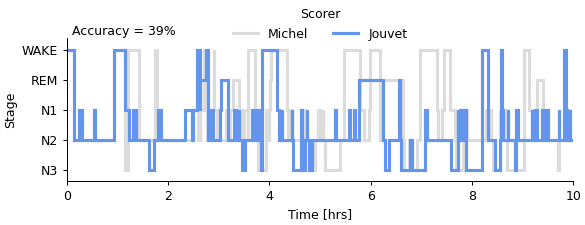
Evaluation includes averaged agreement scores, one-vs-rest agreement scores, agreement scores summarized across all sleep and summarized by sleep stage, and various plotting options to visualize the two hypnograms simultaneously. See examples for more detail.
For a complete walkthrough of the evaluation pipeline of Menghini et al. (2021), see the Evaluating a wearable or staging algorithm against a reference tutorial.
Added in version 0.7.0.
- Parameters:
- ref_hypsiterable of
yasa.Hypnogram A collection of reference hypnograms (i.e., those considered ground-truth).
Each
yasa.Hypnograminref_hypsmust have the samescorer.If a
dict, key values are used to generate unique sleep session IDs. If any other iterable (e.g.,listortuple), then unique sleep session IDs are automatically generated.- obs_hypsiterable of
yasa.Hypnogram A collection of observed hypnograms (i.e., those to be evaluated).
Each
yasa.Hypnograminobs_hypsmust have the samescorer, and this scorer must be different than the scorer of hypnograms inref_hyps.If a
dict, key values must match those ofref_hyps.Important
It is assumed that the order of hypnograms are the same in
ref_hypsandobs_hyps. For example, the third hypnogram inref_hypsandobs_hypsmust come from the same sleep session, and they must only differ in that they have different scorers.See also
For comparing just two hypnograms, use
yasa.Hypnogram.evaluate.- subjectsNone, dict, or array-like
The subject of each sleep session, for datasets with several nights per subject (repeated measures). Either a
dict(orpandas.Series) that maps each session ID (the keys ofref_hyps, or1, 2, ...ifref_hypsis a list) to a subject ID, or an array-like with one subject ID per hypnogram, in the same order asref_hyps. IfNone(default), each session is treated as coming from a different subject.When
subjectsis given,summaryandget_confusion_matrix_proportionalaverage the nights of each subject first, and then average across subjects, so that each subject counts equally regardless of its number of nights. Their bootstrap resamples subjects instead of nights. The subject IDs are also added to the output ofget_sleep_stats, which passes them on toSleepStatsAgreement. See Several nights per subject.Added in version 0.8.1.
- ref_hypsiterable of
Notes
Epochs scored as artefact (
ART) or unscored (UNS) by either scorer are excluded from all epoch-by-epoch analyses (agreement scores and confusion matrices), since they are not a sleep stage. They are kept in the hypnograms themselves, e.g. inget_sleep_statsandplot_hypnograms.Changed in version 0.8.0:
ARTandUNSepochs were previously counted as regular stages.References
[Menghini2021]Menghini, L., Cellini, N., Goldstone, A., Baker, F. C., & de Zambotti, M. (2021). A standardized framework for testing the performance of sleep-tracking technology: step-by-step guidelines and open-source code. SLEEP, 44(2), zsaa170. https://doi.org/10.1093/sleep/zsaa170
Examples
>>> import yasa
>>> ref_hyps = [yasa.simulate_hypnogram(tib=600, scorer="Human", seed=i) for i in range(10)]
>>> obs_hyps = [h.simulate_similar(scorer="YASA", seed=i) for i, h in enumerate(ref_hyps)]
>>> ebe = yasa.EpochByEpochAgreement(ref_hyps, obs_hyps)
>>> agr = ebe.get_agreement()
>>> agr.head(5).round(1)
          accuracy  balanced_acc  kappa  mcc  precision    f1
sleep_id
1             30.6          26.0    0.1  0.1       30.6  30.6
2             33.3          32.7    0.1  0.1       34.9  33.5
3             35.1          23.9    0.1  0.1       34.8  34.6
4             22.5          21.4    0.0  0.0       20.6  20.5
5             21.4          16.9   -0.1 -0.1       20.3  20.7
>>> ebe.get_agreement_bystage().head(12).round(1)
                fbeta    npv  precision  recall  specificity  support
stage sleep_id
WAKE  1            39.1    ...       37.1    41.3          ...    189.0
      2            29.9    ...       27.6    32.6          ...    184.0
      ...
N1    1            18.5    ...       18.5    18.5          ...    124.0
      2            12.1    ...       13.1    11.2          ...    160.0
>>> ebe.get_confusion_matrix(sleep_id=1)
YASA   WAKE  N1   N2  N3  REM
Human
WAKE     78  24   50   3   34
N1       23  23   43  15   20
N2       60  58  183  43  139
N3       30  10   50   5   32
REM      19   9  121  50   78
>>> import yasa
>>> import matplotlib.pyplot as plt
>>> ref_hyps = [yasa.simulate_hypnogram(tib=600, scorer="Human", seed=i) for i in range(10)]
>>> obs_hyps = [h.simulate_similar(scorer="YASA", seed=i) for i, h in enumerate(ref_hyps)]
>>> ebe = yasa.EpochByEpochAgreement(ref_hyps, obs_hyps)
>>> fig, ax = plt.subplots(figsize=(6, 3), constrained_layout=True)
>>> _ = ebe.plot_hypnograms(sleep_id=10)
>>> import yasa
>>> import matplotlib.pyplot as plt
>>> ref_hyps = [yasa.simulate_hypnogram(tib=600, scorer="Human", seed=i) for i in range(10)]
>>> obs_hyps = [h.simulate_similar(scorer="YASA", seed=i) for i, h in enumerate(ref_hyps)]
>>> ebe = yasa.EpochByEpochAgreement(ref_hyps, obs_hyps)
>>> fig, ax = plt.subplots(figsize=(6, 3))
>>> _ = ebe.plot_hypnograms(
...     sleep_id=8, ax=ax, obs_kwargs={"color": "red", "lw": 2, "ls": "dotted"}
... )
>>> plt.tight_layout()
>>> import yasa
>>> import matplotlib.pyplot as plt
>>> ref_hyps = [yasa.simulate_hypnogram(tib=600, scorer="Human", seed=i) for i in range(10)]
>>> obs_hyps = [h.simulate_similar(scorer="YASA", seed=i) for i, h in enumerate(ref_hyps)]
>>> ebe = yasa.EpochByEpochAgreement(ref_hyps, obs_hyps)
>>> session = 8
>>> fig, ax = plt.subplots(figsize=(6.5, 2.5), constrained_layout=True)
>>> style_a = dict(alpha=1, lw=2.5, ls="solid", color="gainsboro", label="Michel")
>>> style_b = dict(alpha=1, lw=2.5, ls="solid", color="cornflowerblue", label="Jouvet")
>>> legend_style = dict(
...     title="Scorer", frameon=False, ncol=2, loc="lower center", bbox_to_anchor=(0.5, 0.9)
... )
>>> ax = ebe.plot_hypnograms(
...     sleep_id=session, ref_kwargs=style_a, obs_kwargs=style_b, legend=legend_style, ax=ax
... )
>>> acc = ebe.get_agreement().at[session, "accuracy"]
>>> _ = ax.text(
...     0.01, 1, f"Accuracy = {acc:.0f}%", ha="left", va="bottom", transform=ax.transAxes
... )
When comparing only 2 hypnograms, use the
evaluatemethod:>>> hypno_a = yasa.simulate_hypnogram(tib=90, scorer="RaterA", seed=8) >>> hypno_b = hypno_a.simulate_similar(scorer="RaterB", seed=9) >>> ebe = hypno_a.evaluate(hypno_b) >>> ebe.get_confusion_matrix() RaterB WAKE N1 N2 N3 RaterA WAKE 71 2 20 8 N1 1 0 9 0 N2 12 4 25 0 N3 24 0 1 3
Methods
__init__(ref_hyps, obs_hyps[, subjects])get_agreement([sample_weight, scorers, pooled])Return a
pandas.DataFrameof weighted (i.e., averaged) agreement scores.get_agreement_bystage([beta, zero_division])Return a
pandas.DataFrameof unweighted (i.e., one-vs-rest) agreement scores.get_confusion_matrix([sleep_id, agg_func])Return a
ref_hyp/obs_hypconfusion matrix from either a single session or all sessions concatenated together.Return the group-level proportional confusion (error) matrix, i.e. the mean, standard deviation, and confidence interval across sessions of the row-normalized per-session confusion matrices, as reported in Menghini et al. (2021).
Return a
pandas.DataFrameof sleep statistics for each hypnogram derived from both reference and observed scorers.multi_scorer(df, scorers)Compute multiple agreement scores from a 2-column dataframe (an optional 3rd column may contain sample weights).
plot_hypnograms([sleep_id, legend, ax, ...])Plot the two hypnograms of one session overlapping on the same axis.
summary([by_stage, ci_method, confidence, ...])Return group-level agreement scores.
Attributes
A
pandas.DataFrameincluding all hypnograms, without the epochs scored asARTorUNSby either scorer.The number of unique sleep sessions.
The number of unique subjects.
The name of the observed scorer.
The name of the reference scorer.